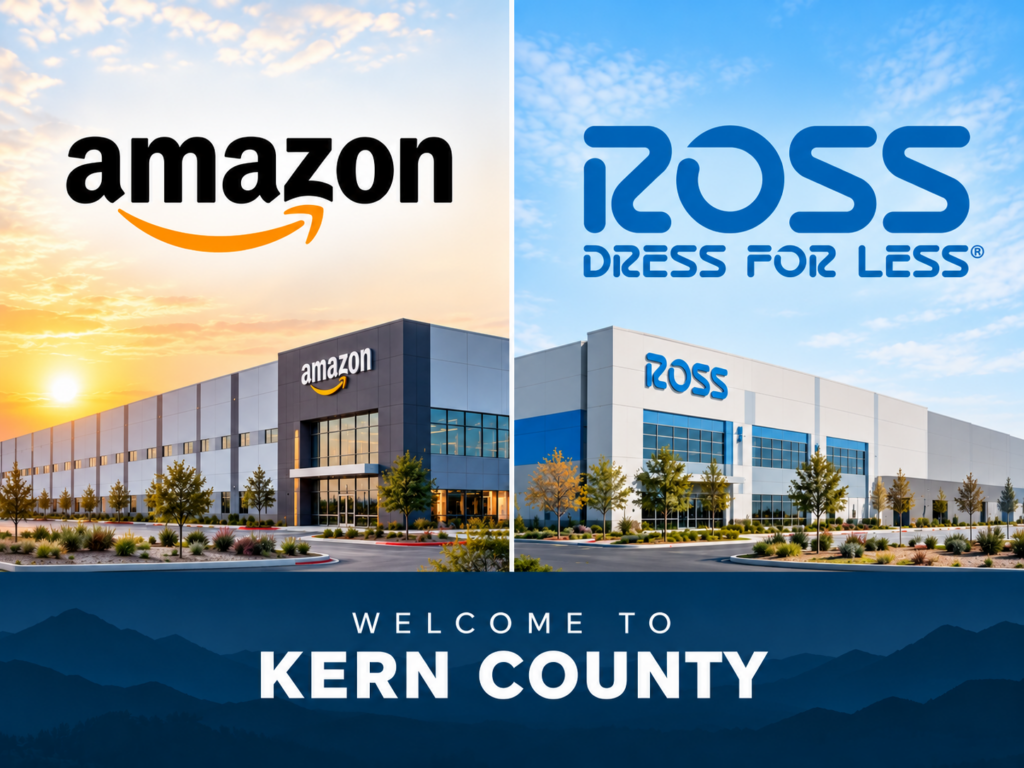
Ross stores plans to build new $500M distribution center in Bakersfield

BAKERSFIELD, Calif. (KGET) — The city of Bakersfield announced Wednesday it has been chosen as the location for Ross Stores’ 10th distribution center, the planned half-a-billion-dollar investment expected to create nearly 1,000 new jobs, according to city officials.

The 1.75-million-square-foot processing and distribution center is set to be near the corner of East Belle Terrace and Mount Vernon Avenue, city officials said in a press release.

It would be the second Ross distribution center in Kern County, following the existing center in Shafter.

Ross plans to invest about $500 million to develop the center through a multi-year project, which is expected to break ground in 2027, according to the city.

City Manager Christian Clegg said in the release that the new center is “the largest job generating project sited in Bakersfield in decades,” calling it a great win for the city and the nearby regions.

“This is an important step and signal in our efforts to grow and diversify our economy, Clegg said. “We showed we can fast track, use our development streamlining muscles, form partnerships and have a customer-first approach for this project.”

Ross is planning on recruiting locally for employees for the new distribution center, which is projected to bring hundreds of new jobs, according to the release.

“We are excited to expand our presence in the Greater Bakersfield area with the opening of a processing and distribution center in the city of Bakersfield,” said Rob Kummerer, Executive Vice President of Supply Chain, Ross Stores, Inc.

“This facility will strengthen our operations, support continued growth and create new employment opportunities in the community. We are grateful for the partnership and support of the many state and local leaders whose collaboration helped make this project possible.”

Mayor Karen Goh welcomed Ross Stores and the city’s partnership with the company, saying Ross offers many job opportunities for Bakersfield residents. According to Goh, the labor force income reinvested in the community is expected to result in an annual economic impact of over $100 million.

She thanked city staff, the site consultants and more who assisted in making the project possible.

Source: Ross Stores plans to build new distribution center in Bakersfield, investing $500M | KGET 17 News

MAJOR GLOBAL TECHNOLOGY COMPANY ACQUIRES 1.1 MILLION-SQUARE-FOOT FACILITY AT WONDERFUL LOGISTICS CENTER

Transaction expands buyer’s footprint at Wonderful Logistics Center to more than three million square feet

SHAFTER, CA, September 14, 2026 – The Wonderful Company has announced that its Wonderful Real Estate business has completed the sale of 5104 Express Avenue to a major global technology and e-commerce company. The newly constructed 1,088,047-square-foot, Class A industrial facility is located at the Wonderful Logistics Center in Shafter, Calif. and marks the buyer’s third location at the 2,000-acre, fully entitled, master-planned logistics and distribution campus, bringing its owned and leased footprint to more than 3 million square feet.

“Global operators continue to choose Wonderful Logistics Center because we are a model within the state and the country that offers something fundamentally different. Nowhere else is there a master-planned logistics hub that brings together large-scale distribution, workforce and community development, and the future of clean freight infrastructure,” said Joe Vargas, president of Wonderful Real Estate. “This buyer’s continued investment validates the strength of Wonderful Logistics Center as one of California’s leading models for responsible logistics and durable economic growth that benefits businesses, workers and communities alike.”

More than 17 million square feet of warehouses are in operation at Wonderful Logistics Center today, supporting 23 tenants, including multiple Fortune 100 companies, and approximately 13,000 jobs—more than half of Kern County’s logistics workforce. 5104 Express Avenue was developed on a speculative basis to accommodate large-scale distribution and manufacturing users. It features a 40-foot clear height, 216 dock-high doors, two grade-level doors, 455 automobile parking spaces and 939 trailer stalls. Cushman & Wakefield Executive Vice Chairman Phil Lombardo, Vice Chair Andrew Starnes and Senior Director Cruise Adams represented the seller, while KBC Advisors Partner Colin MacMillan represented the buyer during negotiations for 5104 Express Avenue.

Last year, the buyer also partnered with Bakersfield College and The Wonderful Company to launch a 12-week Mechatronics & Robotics Apprenticeship program for U.S. employees at the on-site Wonderful Career Center, providing hands-on, SACA-certified training to prepare employees for skilled technical roles and career advancement. To date, more than 100 student employees have graduated from the program and entered year-long apprenticeships before they transition into mid-level technical roles at the company.

Wonderful Logistics Center continues to advance a long-term vision for a fully integrated logistics and goods movement ecosystem. Reflecting more than 30 years of master-planning and coordinated development, Wonderful Logistics Center leverages its strategic location to reduce transportation costs, improve supply chain efficiency and lower emissions. The campus includes an operational inland container depot supporting major ocean carriers, with capacity for up to 34,000 containers at full buildout. Wonderful Logistics Center is also working with public- and private-sector partners to develop a zero-emission truck corridor connecting the ports to Shafter, and the center will introduce California’s first inland rail terminal in 2027, offering both domestic and international service. Together, these investments will help reduce roadway congestion and diesel emissions, delivering meaningful community benefits while strengthening Shafter’s role as a global trade gateway.

“California’s economic growth depends on a more efficient goods movement system,” Vargas added. “We continue to develop best-in-class facilities that leverage our scale, speed to market and transportation connectivity, while investing opportunities that help neighboring communities thrive in the long-term.”

About Wonderful Logistics Center

Wonderful Logistics Center is a 2,000-acre, fully entitled, master-planned logistics and distribution campus located in Shafter, California, approximately 100 miles north of Los Angeles. With more than 17 million square feet completed and operating across 23 tenant companies, Wonderful Logistics Center accommodates facilities ranging from 100,000 square feet to more than 2 million square feet for leading companies across retail, e-commerce, food, manufacturing and logistics. Located near Highway 99, Interstate 5 and Highway 58, Wonderful Logistics Center’s advanced transportation network includes BNSF mainline connectivity, onsite rail infrastructure, an operational inland container depot, a developing zero-emission truck corridor and an inland rail terminal expected to begin domestic and international service in early 2027. Onsite resources include the Wonderful Career Center, La Cocina restaurant and shared event space, with a new health clinic expected to open in fall 2027. These amenities support employees, local residents and the broader Shafter community.

For more information, visit www.wonderfullogisticscenter.com.

About Wonderful Real Estate

Wonderful Real Estate is a professional real estate development and property management company owned by The Wonderful Company that develops, manages and invests in a diversified portfolio of real estate, with a particular focus on office and industrial properties. Leveraging over 30 years of experience in commercial real estate, Wonderful and its affiliates currently have over 10 million square feet of real estate holdings, consisting of owner-occupied industrial and commercial real estate for its operating businesses and approximately 7 million square feet of actively managed office and industrial properties occupied by third parties located mainly in Southern and Central California.

Wonderful Real Estate and its affiliates have invested almost $2 billion since 2008 in commercial real estate development, facility improvements, processing equipment and real estate acquisitions. Wonderful and its affiliates are also currently developing three business parks totaling over 1,865 acres for office and industrial use in California’s Central Valley, several parcels of which have already been sold or leased to Fortune 500 companies and other high-quality anchor tenants.

About The Wonderful Company 

The Wonderful Company is a privately held $6 billion company committed to offering high-quality, healthy brands and helping consumers make better choices, every day.

The company grows, harvests, bottles, packages, and markets a diverse range of products, including fruits, nuts, flowers, water, wines and juices. It is the world’s leading grower of tree nuts and America’s largest citrus grower. In addition to Wonderful Pistachios & Almonds, Wonderful Citrus, and POM Wonderful, its brands include FIJI Water, the world’s largest flower delivery service Teleflora, and JUSTIN, Landmark and Lewis Cellars wines.


Media Contacts:

Erin Poulson Morris

Senior Director of Business Development, Wonderful Real Estate

erin.poulson.morris@wonderful.com

Alison Day

Manager of External Communications, The Wonderful Company

alison.day@wonderful.com

2 Major deals in one week

Sept 17, 2026

Bakersfield is having a major industrial moment.

Two announcements this week make the opportunity especially clear:

Amazon has acquired a newly constructed 1,088,047-square-foot Class A distribution facility at Wonderful Logistics Center in Shafter. The building includes 40-foot clear height, 216 dock-high doors, hundreds of trailer stalls and expandable 4,000-amp electrical service.

This is Amazon’s third location at the logistics center, bringing its total footprint there to more than 3 million square feet. The campus now exceeds 17 million square feet of operating warehouse space, with 23 tenants and approximately 13,000 jobs.

At the same time, Ross Stores selected Bakersfield for a new 1.75-million-square-foot processing and distribution center near East Belle Terrace and Mount Vernon Avenue. The project represents approximately $500 million in investment and is expected to create nearly 1,000 jobs.

From a broker’s perspective, these announcements send a powerful message:

Bakersfield and Shafter are no longer simply competing for industrial users. We are competing successfully for major institutional capital, national logistics operators and long-term corporate commitments.

The fundamentals are compelling:

• Strategic access to Highways 99 and 58, I-5 and major California markets • Available land for large-scale industrial development • Lower occupancy and operating costs compared with many coastal markets • A growing labor force and substantial employment base • Proven infrastructure and an expanding logistics ecosystem • Local leadership willing to streamline development and collaborate with users

These projects will create demand far beyond the buildings themselves—including truck terminals, IOS yards, suppliers, packaging companies, maintenance operations, automation providers, cold storage, food-related users and smaller logistics facilities.

For developers, landowners and investors, the takeaway is simple:

The time to study Bakersfield is before the next wave of demand fully arrives—not after every major parcel has been absorbed.

Bakersfield is building momentum, and the market is increasingly proving that it can support large-scale industrial investment.

Exciting news for Bakersfield and the entire Central Valley.

Source: Eric Powers (7) 2 MAJOR DEALS IN 1 WEEK… BAKERSFIELD, CA. | LinkedIn

Regional Agricultural Manufacturer Leases Entire Former Quad/Graphics Plant In Merced

A regional agricultural manufacturer has leased the entire former Quad/Graphics plant in Merced, returning the approximately 500,000-square-foot facility to industrial use. Industrial Realty Group announced the full-building lease for the property at 2201 Cooper Ave., which sits on approximately 42.6 acres near Highway 99.

The facility includes manufacturing and warehouse space, an on-site electrical substation, employee and trailer parking and land available for potential expansion. The property is also served by Union Pacific and BNSF rail lines, with interior and exterior rail access that can be used to transport raw materials and finished products. Industrial Realty Group Chief Investment Officer Justin Lichter said the property’s infrastructure, rail access and location in the Central Valley made it well suited for agricultural manufacturing.

The lease fills a large industrial property that became available after Quad/Graphics ended operations at the Merced plant in 2023. The commercial printing company had operated at the Cooper Avenue location for decades. Industrial Realty Group later acquired the facility and marketed it for manufacturing, warehousing and distribution use. The property’s location provides access to Highway 99 and agricultural operations throughout Merced County and the San Joaquin Valley. Industrial Realty Group owns and manages industrial and commercial properties across the United States.

https://losbanosenterprise.com/business/industry/2026/regional-agricultural-manufacturer-leases-entire-former-quad-graphics-plant-in-merced/

Kristina Gallagher brings statewide policy experience to Madera County economic development leadership

After building a career in state government, legislative affairs and local government advocacy, Kristina Gallagher is helping shape the next chapter of Madera County’s economy. Since becoming executive director of the Madera County Economic Development Commission (MCEDC) in 2024, Gallagher has focused on attracting new investment, supporting local businesses and building partnerships that strengthen the county’s long-term economic future.

In this Executive Profile, Gallagher discusses her career journey, the opportunities and challenges facing Madera County, and the personal experiences that continue to shape her leadership.


What we do:

We work to position Madera County as an economically viable and vibrant county by aggressively pursuing growth avenues for new and existing businesses, thereby maximizing employment opportunities, the tax base and the quality of life.

What are your roots in the Central Valley?

Kristina Gallagher: I moved to Madera County from Galt, California, in 2024 to accept the executive director position with the MCEDC. In my previous position, I had the opportunity to work with county leaders throughout the Central Valley and grew to understand the issues they faced and found that their values closely aligned with my own.

I ultimately decided to put down roots and purchased a home. The strong sense of community, family and excellent schools made it an easy decision. I knew it was the right place to raise my daughter, and I couldn’t be happier to call Madera County home.

Tell us about your career.

My career path took an unexpected turn because of a deeply personal tragedy. In April 2023, my husband and the father of my daughter was killed in a horrific car accident. That loss changed my life and everything I had ever known.

When the opportunity at MCEDC came along, I knew it was the right next step. Moving from Galt to Madera meant leaving behind everything familiar, but it also gave me and my daughter a chance for a new beginning. While I continue to navigate that loss, I’m grateful for the welcoming community and renewed sense of purpose I’ve found here.

Before joining MCEDC, I worked for the California State Association of Counties, where I worked on legislation and secured state funding for housing and transportation initiatives. I also worked at a Sacramento lobbying firm representing local governments, nonprofit organizations and trade associations, and earlier in my career served in Gov. Jerry Brown’s constituent affairs unit.

Looking back, each step of my career has prepared me for this role. Housing, transportation, business and the political environment are all interconnected, and each plays a vital role in economic development.

Tell us about your current position.

A huge part of my job is bringing people together at the table. I work closely with businesses, developers, state and local government officials to build partnerships and advance initiatives that create opportunities that benefit the entire community.

My primary focus is business attraction, expansion and retention. I work with local businesses to understand their challenges, identify solutions and connect them with resources that help them remain and grow in Madera County.

How would you describe the current economic landscape in Madera County and the opportunities you see ahead?

I believe we’re at such an exciting moment in Madera County’s history. While many communities across California have experienced slower housing and population growth, Madera County continues to thrive, ranking second in the state for housing growth and third for population growth, according to the California Department of Finance.

At the same time, we are not immune to the challenges facing rural communities across California. Inflation, unfunded state mandates and an evolving political landscape continue to impact businesses and economic development efforts.

We need to continue advocating for policies that support sustainable growth, job creation and the business community.

What role does MCEDC play in strengthening the county’s economic future?

MCEDC’s role is to support our existing businesses while also attracting new opportunities to Madera County.

Although we’re a small team of three, we accomplish a great deal by working closely with our local governments, business community and regional partners. Our business assistance and office manager oversees business support programs, while our manager of business development and marketing leads our marketing and community engagement efforts.

What has been your most rewarding part of serving as executive director?

It has been the opportunity to build relationships and advocate for Madera County.

One accomplishment I’m proud of was organizing MCEDC’s legislative mission to Sacramento, where several of our board members met with state legislators to share Madera County’s opportunities, challenges and priorities.

I was also honored to help Gimme Health Foods Inc. secure the highly competitive CalCompetes Tax Credit, which will help create jobs and strengthen our local economy.

What are some of the challenges you have faced so far in your career?

Like in any career, there are always challenges, but I’ve learned how important it is to have people who believe in your potential.

Sometimes it only takes one person to offer encouragement or take a chance on you. I’ve been really fortunate to have a supportive family, along with mentors and leaders who have helped guide me throughout my career.

What was your very first job, and what did you learn from it?

My first job was as a teacher’s aide at the Lawrence Family Jewish Community Center’s preschool in La Jolla during my college summer breaks. I loved working with kids and had the best time, but it definitely taught me patience.

Any hobbies outside of work?

I enjoy spending time with my daughter and playing tennis.

Fun fact: I earned a full-ride tennis scholarship to Utah State University, and I still love getting out on the court whenever I have the chance.

https://thebusinessjournal.com/kristina-gallagher-madera-county-economic-development-commission/

Solar component makers plans 600 jobs

Solar components manufacturer AMPS is proposing to establish a solar module assembly facility located at 10652 Jackson Ave., the former Del Monte plant on the outskirts of Hanford. The vacant facility is huge at 1.3 million square feet. Del Monte closed the processing plant in 2025.

Now Kings County will get some of those jobs back if this deal goes through.

According to a public notice, the solar module assembly facility (up to 8 gigawatts) includes production line installation inside an existing industrial facility with no building expansion or structural changes. There are no hazardous manufacturing processes proposed. The project proposal is limited to interior equipment installation and solar module assembly operations within existing buildings. Operations will include automated assembly lines, packaging, warehousing, shipping, receiving, and related office and support uses.

Phase 1 will include assembly lines in Warehouse #1 and Warehouse #2 and finished product storage and distribution in Warehouse #3 and Warehouse #4. Phase 2 includes future expansion of assembly into Warehouse #3 and/or Warehouse #4 if needed. There will be an estimated 10-20 truck trips per day during operations. The facility will operate up to 24 hours a day, seven days a week, depending on demand, and will have approximately 200 employees per shift or 600 total.

AMPS is a Hesperia-based manufacturer located just on the outskirts of Los Angeles. AMPS stands for American Made Power Solution.

“At AMPS, we proudly manufacture our high-quality solar products in Southern California, operating from two state-of-the-art factories. These facilities leverage the latest solar technology to ensure reliability and efficiency. By adhering to strict quality and safety standards, we deliver exceptional products that support the local economy and promote sustainability. Choose AMPS for solar solutions that exemplify American craftsmanship and innovation,” their website boasts.

The company serves residential, commercial, industrial (C&I), and utility-scale projects. Currently it operates out of a 150,000 square foot advanced manufacturing facility in Southern California. It has been expanding its production lines to reach an annual manufacturing capacity of 1.5 GW.

https://hanfordsentinel.com/business/agriculture/solar-component-makers-plans-600-jobs-john-lindt/article_fb64ae42-8702-4c01-b6bd-91ef1002f0f3.html

Where Is Homeownership Most Accessible for Young People? 2026

Metros where young homeownership is most accessible

While affordability headwinds have begun to stall progress on a national scale, our analysis identifies geographical havens where the path to the American Dream remains wide open. These areas stand out for having a high share of homeowners under 35, a high percentage of mortgage loans taken out by younger buyers, or both. Based on our research and data, here are the 10 metropolitan areas where entry into the housing market is most accessible.

1. Baton Rouge, Louisiana

Baton Rouge claims the No. 1 spot this year, climbing 18 spots in the rankings from 2025. The metro area is defined by a nation-leading under-35 homeownership rate of 22.1%. This is up significantly from last year’s study, when the rate was 17.6%. Baton Rouge also has the sixth-highest percentage of home purchase loans taken out by under-35 applicants (43.3%).

Supplementary statistics show one possible reason young buyers can enter the market: The median home sale price at the time of analysis was $253,634, the eighth lowest of any metro area we researched.

  • Homeownership rate among people under 35: 22.1% (highest)
  • Share of home purchase loans taken out by applicants under 35: 43.3% (sixth highest)

2. McAllen-Edinburg-Mission, Texas

The McAllen metro area is currently the nation’s powerhouse for youth buying activity. An incredible 46.3% of all home purchase loans in this market go to buyers under 35 — the highest share of any metro in the study. Plus, about one in five homeowners with a mortgage is in this age bracket.

It doesn’t directly affect the ranking, but it’s worth pointing out that the median home sale price of $209,859 is the lowest of the 100 biggest metros in the U.S. Federal Housing Administration loans seem to be especially popular among younger buyers: 48.9% of these loans, which can have down payments as low as 3.5%, were given to applicants under 35.

  • Homeownership rate among people under 35: 20.1% (second highest)
  • Share of home purchase loans taken out by applicants under 35: 46.3% (highest)

3. Grand Rapids-Wyoming-Kentwood, Michigan

Grand Rapids is the top-ranking metro for young homebuyers in the Midwest. The under-35 ownership rate of 19.1% is supported by one of the higher median household incomes of metros in the top 10, at $73,765. The relatively high income keeps the home-price-to-income ratio below average.

  • Homeownership rate among people under 35: 19.1% (third highest)
  • Share of home purchase loans taken out by applicants under 35: 45.9% (second highest)

4. El Paso, Texas

El Paso gets a massive 35-spot jump in the rankings this year, with top 10 finishes in both the metrics we examined. Buyers under 35 utilize a large number of VA home loans; El Paso trails only three metros in the percentage of these loans, backed by the Department of Veterans Affairs, that go to applicants under 35. Also, the metro area’s $246,675 median home sale price is one of the lowest in the U.S.

  • Homeownership rate among people under 35: 17.8% (sixth highest)
  • Share of home purchase loans taken out by applicants under 35: 44.8% (fifth highest)

5. Salt Lake City-Murray, Utah

Only five of the 100 most populous metros finish with top 10 rankings in both metrics of our study — Salt Lake City is one. A high share of homeowners with mortgages are under 35, and a sizable percentage of home loans go to younger applicants. This is in spite of the area having a median home sale price of over $533,000 — by far the highest of any metro that finishes in the top 10 for homeownership accessibility.

  • Homeownership rate among people under 35: 17.5% (eighth highest)
  • Share of home purchase loans taken out by applicants under 35: 42.7% (seventh highest)

6. Buffalo-Cheektowaga, New York

Buffalo is the top location for young buyers in the Northeast, moving up 15 spots from last year. Close to 46% of all home purchase loans are taken out by people under 35 — the third-highest percentage in the U.S. These buyers benefit from home prices that are, on balance, lower than in other large U.S. metros. The median sale price, $244,206, combined with the median younger household income of just over $57,000, gives a home-price-to-income ratio that is 14th lowest out of the 100 metros.

  • Homeownership rate among people under 35: 15.4%
  • Share of home purchase loans taken out by applicants under 35: 45.7% (third highest)

7. Pittsburgh, Pennsylvania

Pittsburgh, like the metro just ahead of it in the rankings, has a high percentage of home loans going to younger purchasers. One likely reason: The ratio of median home sale price to median young household income (3.5) is the lowest in the country, making it easier to qualify for a loan. Additional data shows that applicants under 35 take out a high percentage of all conventional loans issued in the Pittsburgh area.

  • Homeownership rate among people under 35: 15.5%
  • Share of home purchase loans taken out by applicants under 35: 44.9% (fourth highest)

8. Cincinnati, Ohio

Cincinnati is the only metro in the top 10 that maintains its exact position from last year. Young people secure 42.6% of all home purchase loans, the eighth-highest rate in the nation. Mortgage applicants are helped by lower home prices — the median sale price, at just under $286,000, is 23% lower than the national median. Incomes among younger households are right around the national median.

  • Homeownership rate among people under 35: 16.4%
  • Share of home purchase loans taken out by applicants under 35: 42.6% (eighth highest)

9. Colorado Springs, Colorado

Nearly 18% of homeowners with a mortgage in the Colorado Springs area are under 35, the seventh-highest rate, despite home prices being on the expensive side. Of the top 10 metros, it sees the highest number (2,089 in 2024) and highest percentage (41.9%) of VA loans going to borrowers under 35. (El Paso County, Colorado, has one of the highest populations of veterans in the U.S.)

  • Homeownership rate among people under 35: 17.6% (seventh highest)
  • Share of home purchase loans taken out by applicants under 35: 39.7%

10. Bakersfield-Delano, California

There are 12 California metros among the 100 biggest in the U.S. 10 finish at No. 75 or below on our list, one at No. 33, and one — Bakersfield — in the top 10. About one of every six homes with a mortgage is owned by someone under 35, and 41.3% of home purchase loans are taken out by younger applicants. Young borrowers take out over 45% of FHA loans, the third-highest percentage of all metros.

  • Homeownership rate among people under 35: 16.6% (10th highest)
  • Share of home purchase loans taken out by applicants under 35: 41.3%

Metros where young homeownership is least accessible

The metro areas where homeownership is most accessible to younger people are spread across each region of the country. On the other hand, the least welcoming metros are overwhelmingly concentrated in California and Florida, where housing costs and other barriers have made homeownership less achievable.

The metros where homeownership is least accessible for younger buyers are:

  1. North Port-Bradenton-Sarasota, Florida
  2. Anaheim-Santa Ana-Irvine, California
  3. Fort Lauderdale-Pompano Beach-Sunrise, Florida
  4. West Palm Beach-Boca Raton-Delray Beach, Florida
  5. Los Angeles-Long Beach-Glendale, California
  6. Cape Coral-Fort Myers, Florida
  7. Bridgeport-Stamford-Danbury, Connecticut
  8. Oxnard-Thousand Oaks-Ventura, California
  9. Oakland-Fremont-Berkeley, California
  10. Stockton-Lodi, California

Why aren’t young people buying homes in these areas?

Supporting data from metros at the bottom of our rankings underscores how high housing costs have pushed homeownership out of reach for many young adults. In California, metros like Los Angeles and Oakland have home price-to-income ratios that approach 13-to-1. In three metro areas — San Jose, Oakland and San Francisco — the median sale price exceeds $1.2 million.

Florida presents a different affordability challenge. In markets like North Port-Bradenton-Sarasota — the least accessible metro in our study — young buyers face expensive insurance costs. “A lot of first-time homebuyers are still on the fence, waiting for relief on insurance rates, taxes and the overall cost of ownership,” said Cole Murray, a real estate agent based in North Port. As climate-related risks continue to drive insurance premiums higher, many prospective buyers are finding that the true cost of homeownership extends far beyond the mortgage payment. In these regions, the path to homeownership isn’t just difficult — for many, it is becoming impossible.

Data: Homeownership access by metro area

Our 2026 analysis reveals that while certain metros offer the best paths to homeownership for young people, many of the largest population centers put more obstacles in the way. Of the 20 largest metro areas in the U.S., only one ranks in the top 15 for young buyers (Minneapolis, No. 13). Of the 10 largest metros, the next highest-ranking on our list after Minneapolis is Chicago, at No. 49.

The data also highlights how quickly the homeownership picture can change in a given area. Birmingham, Alabama, had the biggest year-over-year jump, from No. 55 to No. 17, and the top 10 metros include eight that were outside it last year. Meanwhile, Raleigh-Cary, North Carolina, fell the most, from No. 36 to No. 65, and a top 10 city from last year, Tulsa, Oklahoma, dropped from No. 4 all the way to No. 22.

Tips for young homebuyers

While higher home prices and other constraints, like a shortage of starter homes, have created roadblocks for young Americans, the dream of owning a home isn’t dead — it just requires a more tactical approach. Navigating today’s market means looking beyond the listing price and understanding the specific financial levers that can turn a renter into a homeowner. By aligning your expectations with local economic realities, you can make homeownership a more realistic goal.

  • Know how much you can afford. Finance experts recommend spending no more than 28% of your gross monthly income on housing. Use a mortgage calculator that factors in your down payment, rate, loan amount and other variables to estimate your monthly payment. Knowing the income needed to afford a home can also help you set a realistic budget. Look beyond the monthly mortgage payment by factoring in local property taxes and homeowners insurance to avoid financial strain.
  • Get preapproved and shop for products. Evangelou, from NAR, recommends shopping around for mortgage products that fit your specific needs and getting preapproved. Don’t assume one size fits all; different lenders offer different loan types, including loans specifically for first-time homebuyers.
  • Explore federal and local programs. Forget what you’ve been told about needing a 20% down payment; many young buyers enter the market with less than 15% down with FHA, VA or USDA loans, or using local assistance programs.
  • Look for supply at your price point. Evangelou notes that general inventory is less important than “affordable listings” — homes priced specifically for what middle-income earners can afford.

Methodology

The ConsumerAffairs Research Team analyzed data from 100 of the most populous U.S. metro areas to identify where homeownership is most attainable for people under 35. Our study focused on two metrics, each weighed at 50%.

  • Homeownership rate: This is the percentage of all owner-occupied units with a mortgage that have a householder under 35. This excludes homes without a mortgage. Mortgage-free ownership is excluded from our percentage in order to emphasize market entry accessibility. Data is from the U.S. Census Bureau (2024).
  • Buying activity: This is the percentage of all home purchase loans that are taken out by applicants under 35. This data provides a real-time look at who is successfully financing home purchases in the current market. It comes from the Home Mortgage Disclosure Act, made available by the Federal Financial Institutions Examination Council (2024).

For each metric, the metro with the highest percentage scored the maximum 50 points, and the metro with the lowest percentage was given a score of zero. Other metros received proportionally scaled scores based on where they fell within the overall range.

Our analysis also incorporated the following supplementary data points for context:

  • Median home sale prices from Zillow (April 2026)
  • Median household income for householders under 44 (including under 25 and 25 to 44 age groups) from the U.S. Census Bureau (2024)
  • Home-price-to-income ratio, calculated by dividing the local median home price by the median income of younger households
  • Trends in homeownership rates from 2020 to 2024 to track long-term momentum and recent shifts
  • Loan type distribution, including the number of conventional, FHA, VA, and USDA loans taken out by borrowers under 35 and the share of these loans taken out by borrowers under 35

https://www.consumeraffairs.com/finance/where-is-homeownership-most-accessible-for-young-people.html

Kings Art Center unveils new mural

After several months of sketching and painting, Jennifer Butts’ mural on the south side of the Kings Art Center was dedicated in a ceremony on Thursday afternoon.

Members of the Kings County Art Center, local officials, as well as art-minded individuals gathered to celebrate the mural and the art center itself.

https://hanfordsentinel.com/lifestyles/kings-art-center-unveils-new-mural/collection_14c66ae7-a76f-401a-a5b8-ae2e4a0898b5.html#5

Idemitsu Renewables Completes $60 Million Financing for 50 Megawatt Central 40 Solar Project in California

SAN FRANCISCO, June 29, 2020 /PRNewswire/ — Idemitsu Renewables, the US-based renewable energy business of Idemitsu Kosan Co., Ltd, announced today it has closed on debt financing for its 50 MWp Central 40 solar project in Stanislaus County, California.

Debt financing was provided by KeyBank National Association. KeyBanc Capital Markets served as sole arranger of the financing. “This project expands Idemitsu Renewables’ operating business in California,” said Cary Vandenberg, Managing Director of Idemitsu Renewables. “We were happy to build upon our existing relationship with KeyBank and to close a successful transaction even amidst the difficulty of the current COVID environment.” “As a part of our continuing support for renewable energy, we are pleased to support the growth of Idemitsu Renewables’ solar business in California,” said Andrew Redinger, Manager Director & Group Head, Utilities Power & Renewables at KeyBanc Capital Markets.

The renewable power generated by Central 40 will be sold through a power purchase agreement with Silicon Valley Power, which serves the City of Santa Clara. Idemitsu Renewables, the US-based renewable energy subsidiary of Idemitsu Kosan Co., Ltd, is a leading solar and storage developer and IPP. The company acquires, develops, owns, and operates utility-scale solar power generation plants; selling the clean energy to help communities both economically and ecologically live in healthier environments. With offices in California and Nevada, Idemitsu Renewables continues to develop its growing pipeline of energy projects. Learn more at http://idemitsurenewables.com/.

https://finance.yahoo.com/news/idemitsu-renewables-completes-60-million-120500052.html

EV Connect, Trillium Complete California’s Central Valley Electric Highway

Electric Vehicle (EV) drivers traveling through California’s Central Valley now have more than 150 miles of State Highway 99 supported by fast-charging stations at three Love’s Travel Stops. The expansion is a result of a partnership between EV Connect and Trillium, Love’s alternative fuel business unit.

The California Electric Highway is an extensive network of charging stations along Interstate 5, Highway 99, and other primary roads throughout California. The completion of the new charging stations expands California’s portion of the nearly 4,000-mile West Coast Electric Highway aimed at providing charging stations every 25 to 50 miles. The initiative is funded through incentives and grants from the California Energy Commission. Funding support is provided by the California Energy Commission’s Alternative and Renewable Fuel and Vehicle Technology Program, which invests in transportation and fuel technology innovation that helps California meet its energy, clean air and climate change goals. EV Connect will operate the charging stations, while Trillium will build the sites and provide ongoing management.

The three Love’s charging sites will feature rates of 50 or 150 kilowatts and accommodate charging for up to four vehicles at one time. The new charging stations, including DC fast chargers (DCFC) and level-2 chargers at Love’s stations in Ripon, Madera and Tulare, use EV Connect’s EV Cloud, an innovative cloud-based software platform for managing electric vehicle charging infrastructure. “We can now provide electric vehicle drivers the same safe and well-maintained travel stop services that we’ve provided to professional truck drivers and everyday motorists since 1964,” said Frank Love, co-CEO of Love’s. “We’re excited to welcome motorists along Route 99 and play a part in reducing emissions through our electric vehicle infrastructure.”

EV Connect provides the industry’s largest open-standards EV charging cloud platform for managing networks of charging stations, their interaction with utilities and the improvement of the driver experience. “Love’s Travel Stops are a mainstay of the American road trip, and we are excited to help roll out charging locations on the nation’s highway system and bring long-distance mobility to electric vehicles,” said Jordan Ramer, founder, and CEO of EV Connect. “We are pleased to work with Trillium to deploy their DCFCs in strategic locations to fulfill part of EV Connect’s deployment program under the California Energy Commission grant program.”

https://www.saurenergy.com/ev-storage/ev-connect-trillium-complete-californias-central-valley-electric-highway